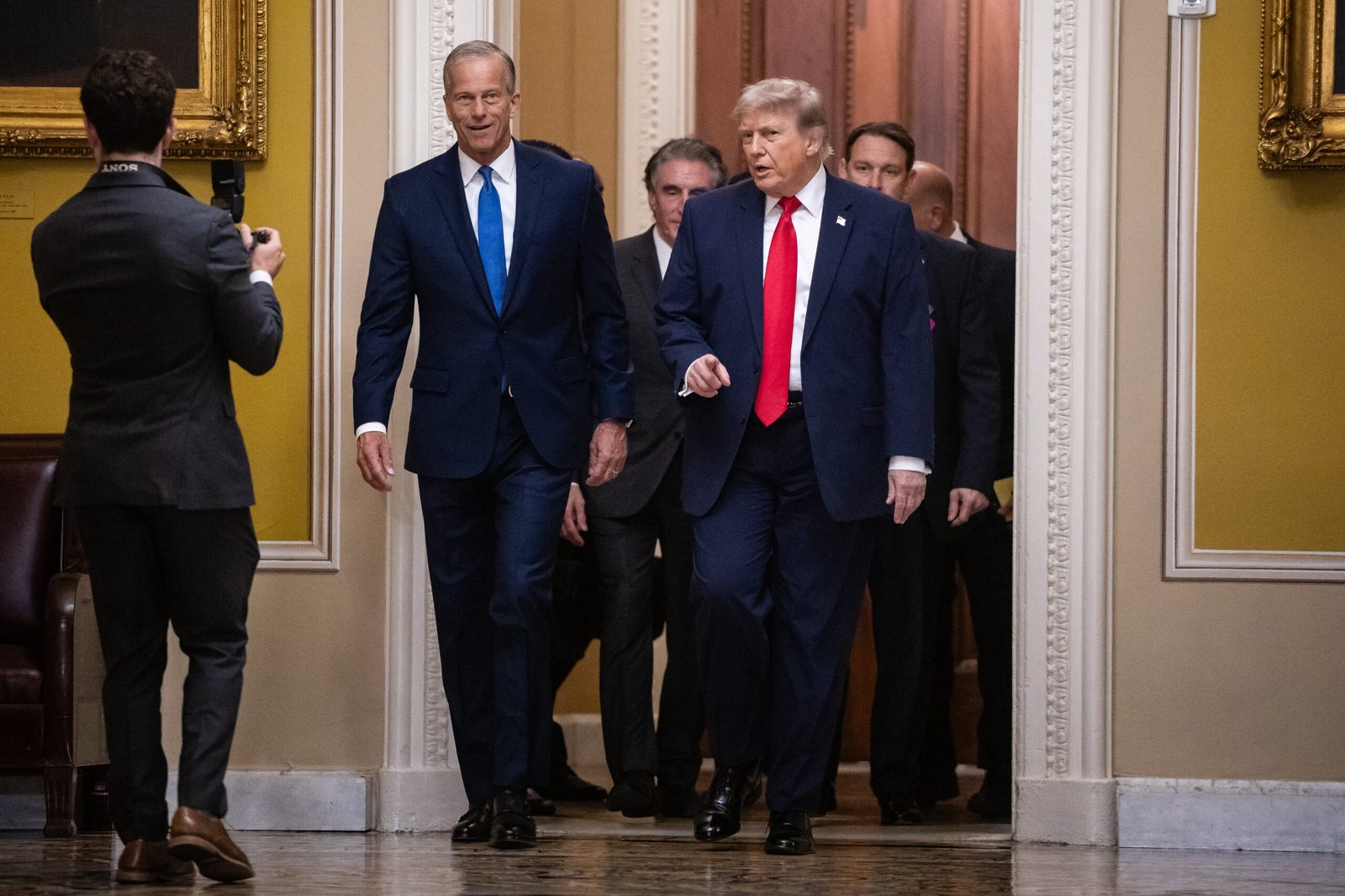
President Donald Trump is showing little urgency in sending nominations to the Senate even as the GOP’s control of the chamber beyond 2026 is increasingly in doubt.
There are more than two dozen federal court vacancies. Labor secretary, FDA commissioner and scores of other open positions do not have nominees, and a senior White House official said Trump is in no rush to fill them.
“Ultimately, we need to have the right people in those positions,” said the official, who was granted anonymity to describe internal thinking. “So if it’s acting for now, so be it. If [it] takes a little while to find that perfect person, then it takes a little while.”
That’s unsettling some Republican senators who are anxious to fill spots ahead of the midterms, a daunting task given the legislative calendar and host of competing GOP priorities.
“We’re running short on time,” said Sen. Tommy Tuberville (R-Ala.), a member of the Senate HELP Committee, which oversees health, labor and other issues. “We’d love to get at least one or two of them and get it in the next tranche.”
As far as judges, Tuberville said he wants to see “as many as we can get” nominated, adding, “I don’t know why we don’t have more.”
Trump’s apparent nonchalance — particularly over judges — is a marked departure from his first term, when he opined that appointing people to the bench might be the “single most important thing you do” as president. But as the Senate left for a two-week recess Thursday, there were only 10 nominees pending for 29 judicial vacancies.
The vacancies come amid ongoing tensions between the Senate and Trump, who has put pressure on the chamber to pass the GOP elections bill known as the SAVE America Act, going so far as to cancel a planned Wednesday signing of a bipartisan housing bill.
Sen. Ted Cruz (R-Texas), a member of the Judiciary Committee, said he “absolutely” wants to see the president nominate more judges before the end of the year. Texas has three court vacancies with zero nominees.
“And that’s one of his greatest legacies, both first term and second,” Cruz said of Trump.
Trump is on pace with his first term in total confirmations in part because Republicans changed the Senate rules last year to confirm slates of civilian posts at once by a simple majority vote.
One tranche confirmed in Mayincluded 49 nominees, from ambassadors to midlevel posts at various federal agencies. So far, 502 of Trump’s second-term nominees have been confirmed, compared to 509 at this point during his first term and 601 at the same point during former President Joe Biden’s term.
Federal judges and members of the Cabinet still have to be confirmed individually, despite the rule change for other posts.
Trump inherited only about 40 judicial vacancies for his current term, fewer than any president since Ronald Reagan. Judiciary Committee Chair Chuck Grassley (R-Iowa) previously complained that the White House hasn’t nominated more judges. More recently, though, he’s blaming his committee for not acting more quickly on the already pending nominees.
“Right now it’s hard for me to blame the White House when in the last three executive weeks, we were supposed to have meetings to vote judges out, we couldn’t have enough members present,” Grassley said in an interview.
A White House official said “Trump plans to nominate well qualified individuals to fill these vacancies.”
Sen. John Kennedy (R-La.) said he’s had “a couple good discussions” with the White House about a circuit court vacancy, which he expects the administration to fill. As a Judiciary Committee member, he can block any nominee that doesn’t get support from Democrats.
“If it’s somebody I support, I’ll vote for them. If it’s somebody I don’t support, I’ll vote no,” Kennedy said. “It’s an important spot. They know I’m on Judiciary, and they know I’ll vote no if I don’t agree.”
The Labor secretary and FDA commissioner picks, meanwhile, go through the HELP committee — chaired by Sen. Bill Cassidy (R-La.), who lost his primary last month after Trump endorsed a challenger.
Republicans have been left in the dark about those nominees, some on the panel say.
Sen. Roger Marshall (R-Kan.) said he’s heard “nothing at all” and “radio silence” from administration. Another GOP senator, granted anonymity to speak candidly, said they’ve heard nothing from the administration about its thinking or plans for a Labor secretary nominee specifically.
The HELP Committee membership poses challenges for the administration. Sens. Lisa Murkowski (R-Alaska) and Susan Collins (R-Maine) previously expressed concerns about Casey Means’ nomination as surgeon general before Trump pulled her, for example. And the dynamic between the president and the chair could be a hurdle, three people granted anonymity to comment on the process said.
“Why give Cassidy a platform to get back at DJT?” one of them said.
Another, a GOP senator, predicted Cassidy would “play games” with nominees who have to go through his committee.
“I really don’t think a lot of senators are in any mood to give the president any wins because they’re frustrated with him,” said the third person, who is close to the White House.
But confirming nominees before he leaves the Senate could be a priority for Cassidy, one of the few Republican doctors to push the administration toward public health nominees who align with established science on issues like vaccines.
A potential successor — Republican Sen. Rand Paul of Kentucky — is a critic of the vaccine and masking standards set during the pandemic and would likely set the committee on a different path.
Recent appointees such as Nicole Saphier for surgeon general and Erica Schwartz for Centers for Disease Control and Prevention director are more mainstream than some past HHS appointees like Means and Dave Weldon, who was nominated for CDC director before the administration determined he didn’t have the votes.
Those nominees have been moving through the regular process, including meeting with Cassidy and other senators ahead of confirmation hearings.
Cassidy told reporters after he lost his primary that he would “vote for the good of my country and the good of my state.”
“There’s some nominees that have not gotten through committee for whatever reason, so that’s not anything new,” he added. “That’ll just be part of the process.”
A HELP Committee spokesperson added Thursday that Cassidy has voted for every Trump nominee and that the panel will “do its job to confirm qualified nominees and serve the American people.”
“Anyone who says otherwise doesn’t know what they’re talking about,” the spokesperson added.
The White House official said “Trump remains committed to nominating highly qualified individuals for a variety of posts that are aligned with the agenda the American people elected him to enact” and will continue to send nominees to the Senate, including to the HELP Committee.
Senate Majority Leader John Thune said in an interview he had not spoken to the White House about their plans for some of the major picks under HELP jurisdiction but he encouraged the administration to send nominees.
“I think it’s always better to have people in permanent positions rather than temporary,” Thune added.
Megan Messerly contributed to this report.