It started with a pledge to expose a Biden-era conspiracy to take down President Donald Trump. It ended with a botched attack over basketball tickets.
Armed with subpoena power in Congress and a friendly Justice Department on their side, Republican lawmakers have spent two years promising to expose former special counsel Jack Smith as the leader of an anti-Trump witch hunt that morphed into a full-blown attempt to take down the Republican establishment.
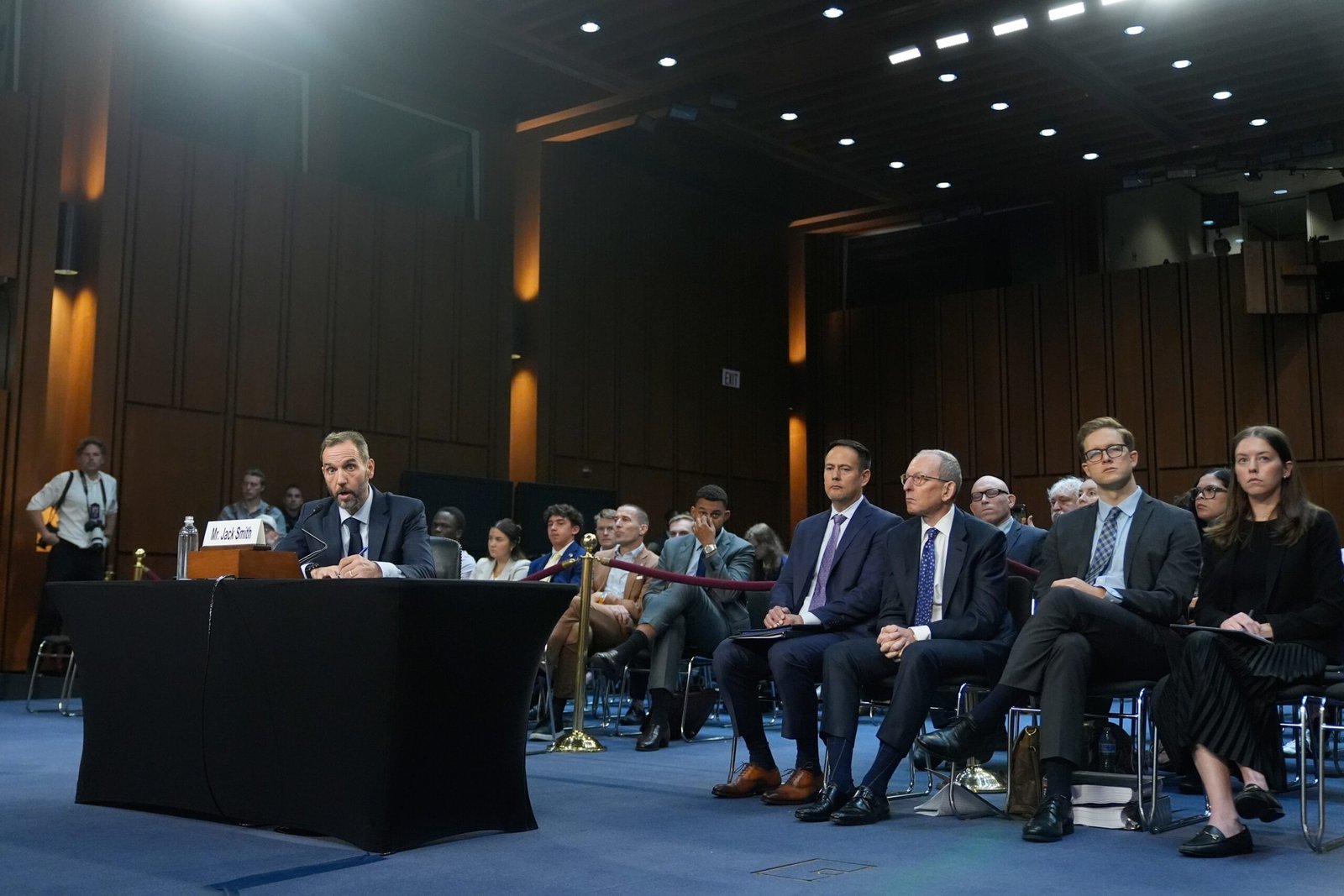
Smith’s appearance Tuesday before the Senate Judiciary Committee — his third time testifying under oath on Capitol Hill, the second time in public — was supposed to be a watershed moment for the GOP intent on extracting a smoking gun ahead of the midterm elections. Instead, the hearing was most memorable for the fusillade of insults hurled by the panel’s Republicans.
Sen. Eric Schmitt of Missouri unsuccessfully sought to implicate Smith in a plot to attend a sporting event as a cover for investigating Trump election interference claims, then called him a “dirtbag.” Sen. John Kennedy of Louisiana said the former prosecutor made him “want to throw up in my mouth.” And Sen. Ted Cruz of Texas, comparing him to “Javert from ‘Les Mis,’” said Smith’s probe was “the most egregious abuse of power in the history of the Department of Justice.”
Senate Judiciary Chair Chuck Grassley insisted the hearing was “not the end” of his investigative work, but the four-hour grilling had the feeling of finality. The Republican-led probe into Smith’s efforts to bring criminal charges against the president has already stretched for two years, and Democrats stand a chance of retaking control of Congress in the midterms.
And at least one Republican member of the panel, Sen. Josh Hawley of Missouri, said he believed the investigation into Smith had run its course in Congress.
“At this point, I think we kind of know what we know,” Hawley said in an interview following the hearing. “I think at this point, it’s up to the DOJ to either prosecute him for perjury for lying under oath, which I think the House has formally referred him for … or try to have him disbarred.”
Judiciary Committee Republicans did little Tuesday to challenge the substance of Smith’s criminal case against Trump for seeking to subvert the 2020 presidential election. Smith reinforced his contention that Trump mounted an unprecedented criminal assault on the transfer of power, seeking to derail Joe Biden’s victory and then capitalizing on the Jan. 6, 2021 riot at the Capitol — unleashed by a mob of his supporters — to further that goal.
Smith also defended the work of his staff and decried the Trump-led Justice Department’s decision to fire them as “illegal.” And he made his most forceful case yet that the probe he led was actually fueled by Republican witnesses who broke from Trump over his handling of the 2020 election.
”It’s very hard to understand how our investigation can be viewed as partisan when the strongest witnesses, the people who were the difference between the rule of law and not, were Republicans,” Smith said.
When Sen. Darline Graham (R-S.C.) ripped into Smith for secretly obtaining her late brother Lindsey Graham’s phone records as part of his inquiry, Smith hailed him as a “patriotic public servant” and who likely would have been a featured witness in Trump’s trial — because he eventually concluded Trump’s election fraud claims were false.
Smith similarly hailed Former Arizona House Speaker Rusty Bowers and former Vice President Mike Pence as heroic figures who were crucial witnesses against the president. Smith ultimately dropped his case after Trump prevailed in the 2024 election. Though he said he remained confident in his ability to secure a conviction at trial, Smith emphasized that Justice Department policy forbids criminal prosecution of a sitting president.
When they weren’t lobbing personal attacks at Smith, Republicans homed in on what they described as procedural flaws of Smith’s investigation. They criticized him for subpoenaing phone records of members of Congress, like Lindsey Graham, who communicated with Trump and his administration during the post-2020 election timeframe.
They hit Smith for securing court orders that prevented telecom companies from alerting lawmakers to those subpoenas, and challenged his respect for the constitutional protections members of Congress are afforded to avoid scrutiny from federal prosecutors. That line of questioning produced one of the only bipartisan moments of the hearing: a pitch by Sens. Chris Coons (D-Del.) and Mike Lee (R-Utah) for legislation that would limit the ability of prosecutors to obtain secrecy orders when they issue subpoenas in sensitive probes.
Lee is poised to be the next chair of the Senate Judiciary Committee in the next Congress if Republicans maintain control of the chamber.
Smith used his appearance, as well as friendly questions from the panel’s Democrats, to parry GOP criticism of his tactics. He followed all Justice Department policies and laws, he insisted, and said he had respect for the separation of powers — including Congress’ constitutional protection from executive branch scrutiny.
Smith said he never targeted GOP lawmakers but pursued critical evidence of Trump’s actions and state of mind that would have been necessary to prove his case in court, and he repeatedly returned to an overarching contention: that he had enough evidence to convict Trump of “one of the most serious crimes that’s ever happened in our nation’s history.”
He also reminded lawmakers what he couldn’t say: anything at all about his charges against Trump for hoarding classified information at Mar-a-Lago. Smith’s findings in that probe remain sealed from public view by U.S. District Judge Aileen Cannon, who has ordered the Justice Department to keep it secret.
Sen. Adam Schiff (D-Calif.) said subpoenaing that report would be one of Democrats’ first actions should they have the majority in the next Congress.
Ultimately, Smith’s hearing Tuesday may end up being best remembered for a high-profile gaffe by Schmitt, who accused Smith of secretly traveling to Atlanta at the very moment local prosecutor Fani Willis — who had also charged Trump over the 2020 election scheme — was facing damaging questions about her conduct. As proof, displayed on an elaborate poster, Schmitt offered text messages suggesting that Smith attended a basketball game on Feb. 3, 2024 — the same day the Atlanta Hawks played the Golden State Warriors.
Schmitt revelled as a clearly flummoxed Smith struggled to discern what Schmitt was talking about.
“I don’t think you know that we have this stuff,” Schmitt said. “So I’ll give you a second to process it so you don’t perjure yourself.”
After a few moments, Smith did recall having attended a basketball game — but not in Atlanta. It wasn’t the Hawks his colleagues were discussing in a series of texts, Smith explained, but the Hawkeyes, whose star Caitlin Clark was playing in Maryland that day.
“It was because Caitlin Clark was coming to Maryland to play, and so we went to the game,” Smith said.
Immediately after the exchange, Sen. Amy Klobuchar (D-Minn.) fact-checked Schmitt in real-time, confirming the date of the Iowa-Maryland game and suggested that her colleagues’ reliance on “false information based on confusion about the name of a team” warranted an apology.
“You don’t call someone a dirtbag when you haven’t done your own research and you don’t have your facts straight,” Klobuchar said after the hearing. “And it just shows how completely out of control this whole thing was.”
Schmitt did not immediately respond to a request for comment on his allegations.
Kelsey Brugger contributed to this report.