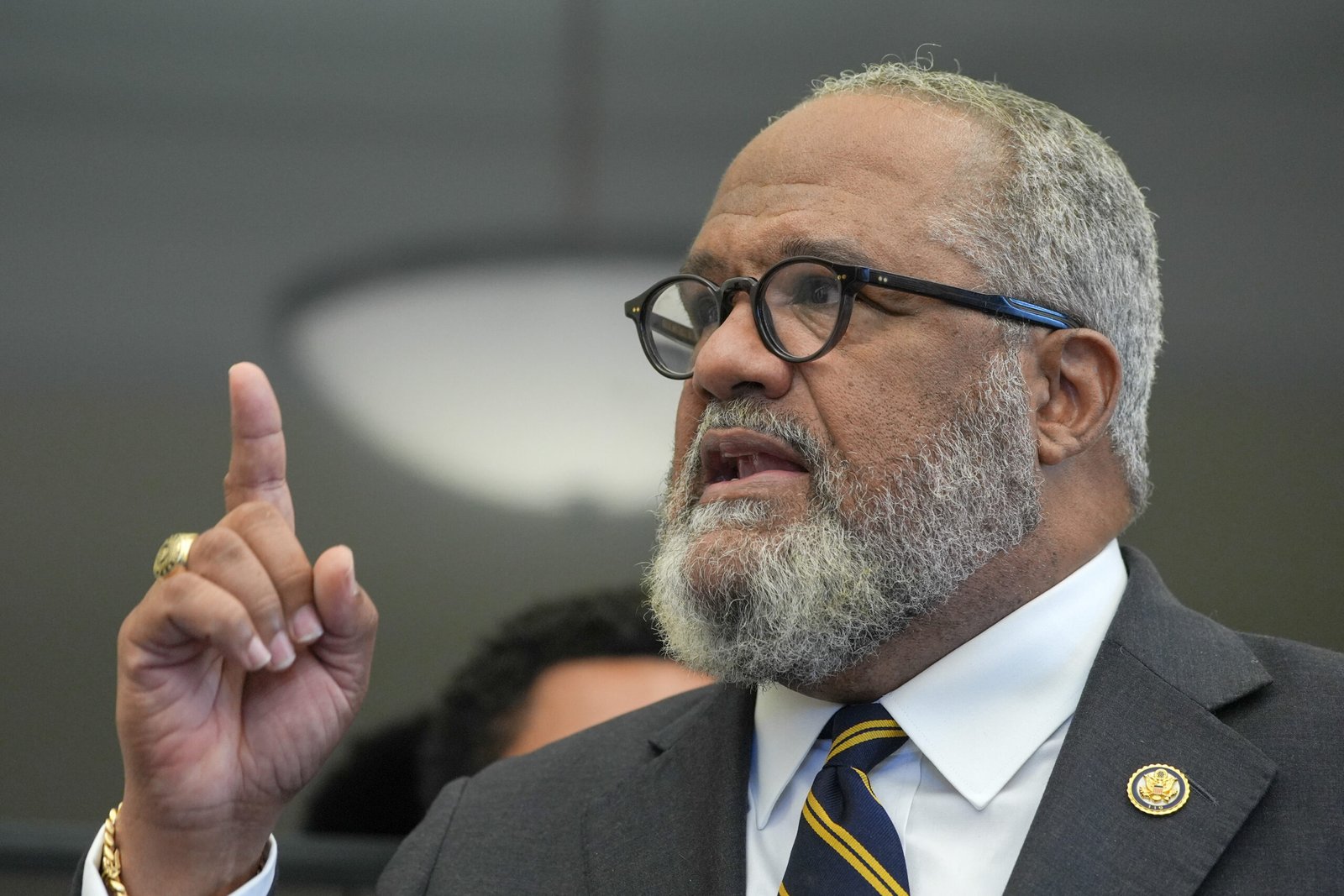
The incoming leader of the Congressional Black Caucus urged his party to focus on affordability and environmental justice in the next Congress — and the voting rights fight that ripped the party apart the last time Democrats controlled both chambers.
In an interview Tuesday, Rep. Troy Carter (D-La.) said the CBC will look to tackle affordability, health care, environmental justice, economic parity and “of course” the John R. Lewis Voting Rights Advancement Act in the new Congress.
“If you ask me to order them, I would tell you they’re all going to be coming at you simultaneously,” said Carter, who is poised to become the next chair of the caucus. The Lewis bill, he added, will be “the mechanism for which all other actions flow.”
The priorities aren’t much different from what Minority Leader Hakeem Jeffries touted as the party’s plans ahead of Election Day. But Democrats have looked to pass some version of voting rights legislation since the original blue wave during President Donald Trump’s first midterms, only to be stymied by Republican opposition and a brutal intraparty fight over the Senate filibuster.
Different iterations of a voting rights bill have been introduced by Democrats since 2019. While sometimes changing in size and scope, at its most expansive it would broadly remake the American elections system, from reinstating a gutted provision of the Voting Rights Act to banning partisan gerrymandering and creating public financing of congressional campaigns.
The version introduced this Congress focused specifically on the Voting Rights Act and restoring “preclearance” requirements — that states or jurisdictions with a history of discrimination get preapproval from the federal government or courts before changing voting laws — and not even more wholesale changes to the country’s election systems.
When Democrats last controlled Congress following the 2020 election, the sweeping bill passed the House amid stiff GOP opposition. It ultimately died in the Senate after then-Sens. Joe Manchin (D-W.Va.) and Kyrsten Sinema (D-Ariz.) fought to keep the filibuster, effectively killing the bill, which did not have enough GOP support to clear the 60-vote threshold.
Under Democratic control, voting rights legislation has recently gotten the symbolic designation as the first piece of legislation introduced in either chamber.
Leaders within the CBC, which was founded in 1971 and is often referred to as the “conscience of the Congress” among its members, hope that the new Congress will have another opportunity to pass the bill.
The CBC projects having at least 66 members, which would be the largest caucus in its history. That number excludes some uncalled races — including Scott Colom in the deadlocked Mississippi Senate race.
The CBC’s new members in the 120th Congress will “absolutely” help the caucus push its agenda forward, including passage of the John R. Lewis Voting Rights Advancement Act, said Rep. Greg Meeks (D-N.Y.).
“Because we have a record number of African Americans in the Senate, we will not only be able to pass it in the House but we’ll have the advocates and the individuals to put it forward to get it passed in the Senate,” Meeks, chair of the CBC’s political arm, told POLITICO.
It is not immediately clear if there is enough support to pass, particularly with the filibuster intact. A number of recently elected Democratic senators have signaled they want to keep the filibuster.
Meeks argued that the CBC’s growth was due in part to investments made by a constellation of CBC-aligned political groups. According to a memo shared with POLITICO, the groups invested $20 million in races across the country, implemented a seven-figure social media creator campaign and targeted Black-led or -owned firms and media outlets for ads ahead of the midterms.
More than a dozen of their 37 targeted House races were seats held by CBC members, including Democratic Reps. Shomari Figures of Alabama and Don Davis of North Carolina, who both won on maps redrawn to defeat them. Figures’ redraw came after another Supreme Court decision that further eroded the Voting Rights Act.
But the CBC, made up entirely of Democratic members, will still need to find a way to work with President Donald Trump to deliver on campaign promises. Meeks appeared unconcerned about the potential hurdle.
“The burden will be on the president,” said Meeks. “But if he continues with his tariffs, if he continues with trying to take away who we are as African Americans by trying to take away our history and destroy the legacy of our leaders, then we’ll have a battle.”